The Two Likenesses
In a town that lay along a wide green river there lived a wood-carver who married a weaver; and in the first year of their marriage they could not stop looking at each other. He would glance up from his bench and find her watching him, and she would look up from her loom and find him watching her, and each time it was as though they saw the other newly — a being just arrived from some brighter country, only lightly disguised in ordinary clothes.
At their wedding an old woman came whom no one had invited, though no one liked to say so, and she brought no gift that could be seen. She took the young husband aside and said to him kindly, "You love to look at her so. But you must go to the forest to cut wood, and she will not always be before your eyes, and you will be lonely for the sight of her. Carve her likeness, then, and carry it in your coat, and when you are far from her you may take it out and look at it, and not grieve." And to the young wife she said the same: "Weave his face into a cloth, and keep it folded at your breast, and your eyes need never be without him." It seemed to both of them the tenderest counsel they had ever been given, and they thanked her, and she went away along the river and was not seen again.
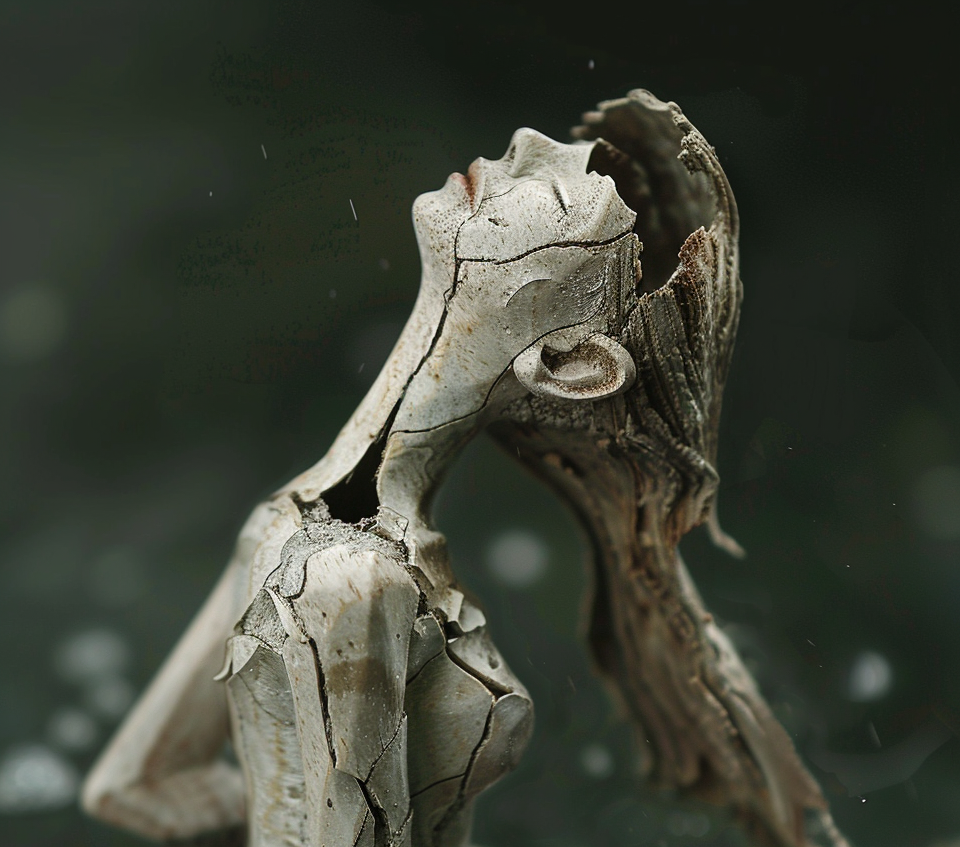
So the husband carved a little figure of his wife, no longer than his hand, and it was a wonder of likeness, for he was a true carver and he made it in love; and the wife wove his face into a small cloth, and it too was a marvel. And in the forest he would take out the little wife and look at her and be comforted, and at her loom the wife would unfold the cloth and find his face there.
Now here was the strange thing about the likenesses, which neither of them had been warned of. The eye is a lazy servant, and loves above all things not to have to look twice. The more the husband gazed at the carved wife — and he gazed at her often, for she was always to hand, and patient, and never turned away — the more his eyes learned her small wooden face by heart. And then a thing happened so slowly that he never marked the day of it: when he came home and looked at his living wife, his eyes, grown certain and idle, no longer troubled to see her. They showed him instead the carving they knew so well, the little fixed face laid over her changing one, like a familiar map unrolled across a living country. He looked at his wife and saw her likeness. He did not know that he did it.
And the carving was by far the easier thing to look upon, for it never altered and never surprised him, and never once looked back at him with a sorrow or a need that he would have to answer; whereas the living face was a kind of weather, never the same from morning to evening, and might at any moment ask something of him. So he came, without ever choosing it, to prefer the likeness — to rest his eyes upon the little wooden wife who made no demand of them — and to call that looking at his wife. And she, across the same table, unfolded her cloth beneath it and rested her eyes upon the woven husband, who was gentler to look at than the tired man before her, and called that seeing him.
So they ceased to see each other. As a face left out in the weather pales and blurs, the husband grew faint and featureless to the wife's eyes, and the wife to his, until they could sit a whole evening across a small table and not once see the person who was there; while the likenesses grew bright and dear and exact, so that the husband's coat dragged at his shoulder with the sweet weight of the little wife, and the wife stooped beneath her cloth as beneath a stone.
One night the two likenesses fell to quarrelling — the carved wife and the woven husband, in the voices of their owners, an old quarrel, the oldest in the house, and they conducted it bitterly and well, far into the dark. And the wood-carver and the weaver, who were very tired, and who were not truly needed for the quarrel since the two likenesses knew all the words by heart, fell asleep at the table while their small effigies fought on between them; for it is always so, that it is our images of one another that quarrel, while the living two, could they only see each other, would find they had nothing to fight about.
At last the husband grew so weary in his eyes and in his soul that he went down at evening to the river, where the green water ran wide and old and patient, and he sat upon a stone, half meaning never to go home again. And out of long habit his hand went to his coat for the little wife, to rest his eyes upon her and be comforted; but his hand was too weary to lift her, and the carved figure slipped from his fingers and fell into the water.
He cried out and reached for it — and then did not. He watched it go. The current turned her once, so that her small carved face looked up at the sky; and then it carried her against a black rock that stood in the river, and there she struck, and shattered — into a hundred pieces, into a thousand, into more pieces than there had been days in all their years together — and the water took the pieces under and scattered them, and in a moment there was nothing on the green water at all, and she was gone.
Then the wood-carver lifted his eyes.
And because the little carved face that had stood for so long between his eyes and the world was gone — broken on the rock, carried under — he saw. He saw the river: not the word, not the grey and certain river he had carried in his head, but the living silver thing it truly was, breathing in the last light, which he had not looked upon in forty years. And he saw, where she had come down to the water on some errand of her own that he knew nothing of, a woman.
She was old. She was grey at the temples, and there was a stillness in her face that he had never carved, because he had never seen it. She was a stranger to him; he was certain he had never in his life set eyes upon her; and yet — and here his breath caught in him — he seemed almost to know her. It was the strangest sensation he had ever felt: that she should be at once the most unknown and the most familiar being in all the world, a face rising from the floor of a dream, a name upon the very tip of the tongue that will not come. He looked, and the knowing and the not-knowing trembled together in him, and he did not dare to move, for fear that she would be lost.
And then it came — not as a thought laid over her, not as something remembered and pressed down upon the living face, but rising up out of the seeing itself, the way warmth rises from a stone that has held the sun all day: he knew her. He knew her not by that worn and dusty word — my wife — which he had laid across her ten thousand times until it hid her altogether, but as herself. She was the girl he had seen once, long ago and across a great distance, on the first day of all: when she too had been a stranger, when neither of them had yet made any image of the other, and so each had looked upon the other whole, and new, and entire, and had not been able to look away. That first seeing, which he had believed lost forever beneath the forty years, was not lost. It was this. He was looking at her, this evening, with the very eyes of the first day; the first time and this time were one time; and the stranger across the water was his first love, given back to him — not as a memory, but as a living woman, here, and now, and never to come again.
For this was the gift the broken likeness had given him, and the whole reward of the unseeing: that with nothing of his own laid across her any longer — no carving, no certainty, no worn and narrow name — she was restored to him entire. Not the small fixed wife he had whittled her down to in his looking, but the whole of her, in all her reality, exactly as she was. He had got her back. He had got the first day back. And his heart turned over in him with fear, and with grief for all the years he had gazed at a little wooden thing and called it looking at her, and with a joy larger than either, that had no name.
She felt his eyes upon her — his true eyes, looking at last — and raised her head, and met them across the running water. And as their eyes met, the cloth at her breast came unfolded of itself, and the threads of the woven husband loosened, and the wind lifted them and let them fall upon the river, and they too were carried away.
And they stood and looked at each other a long time across the water, the way two people look who are meeting for the first time, and are not sure of each other, and are a little afraid, and cannot look away.
From that day the wood-carver and the weaver had no likenesses, and so they were forced to the harder thing, which is to look — really to look — at the one who is there: to be wounded by the changing face, and surprised by it, and to find the other a stranger of an evening, and to begin again. It did not stay. The eye is a lazy servant and would always rather know a thing than see it, and a hundred times a day the old certainty rose up to lay its map across the living face; and a hundred times, with a small hard effort that was really the setting down of all effort, one or the other of them would let the map fall, and look, and see the other new. They were only two now, where there had been four; and they did not grow, as the long-married are said to grow, ever more alike and more unseen, but stranger to each other and more dear, which is a different and a far rarer thing.
And the river carried the two likenesses down through the night and the sugar-cane fields and the sleeping towns, down to where all rivers go; and it carries them still — every likeness that was ever carved or woven or remembered of a beloved, every small fixed face that we lay across a living one and bow to and call by their name — the river takes them all, and breaks them upon its stones, and gives them to the sea, and asks of us only that we lift our eyes, and look, and see who is really there.