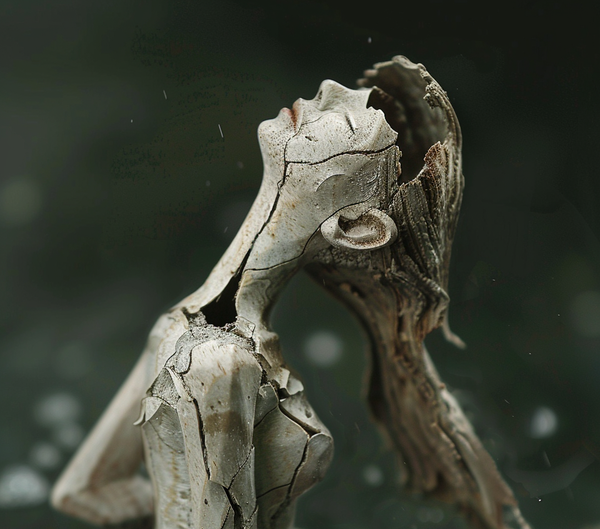
The Roasted Seed

There is a kind of peace you can reach on the cushion that does not survive the drive home.
You sit. The mind quiets. The irritations of the morning loosen their grip, the wanting thins out, and for a while you rest in something clean and wide that feels like freedom. Then someone cuts you off at the on-ramp, or an old name surfaces in your inbox, and the whole apparatus is back — intact, fully furnished, as if it had been waiting in the next room. Which it had.
It helps to think of the tendencies of the mind as seeds. Every habit of reaction you carry — the flinch, the grasping, the particular way your anger or your longing organizes itself — is a seed with a whole plant folded inside it, waiting for water. Most of a life is spent watering them. You meet the conditions that match the seed, the seed sprouts, the reaction grows, and you call it yourself.
Stillness does something to the seed, but it is worth being precise about what.
When you sit and grow quiet and stop feeding the reactions — stop arguing with them, stop acting on them, stop watering — the seeds go dry. A dry seed is dormant. It does nothing. It produces no plant, and the silence around it can be vast and convincing. This is the peace that does not survive the drive home. The seed was never destroyed; it was kept dry. Let the right conditions return — enough pressure, enough fatigue, a lapse in attention — and it takes up water again and sprouts exactly as before, with nothing lost. You can spend years in this dry, quiet field and leave it with every seed still viable.
There is another thing that can happen to a seed. It can be roasted.
A roasted seed looks almost the same. Set it on the table beside a dry one and you could not tell them apart. But the roasted seed has been through fire, and the fire has reached the germ at its center, and that seed will never sprout again no matter how much water you give it. It is present. It is inert. The plant folded inside it is gone, and what remains is only the shape of a seed.
Drying is reversible. Roasting is not. And almost everything that gets called inner work is drying.
So the question is what the fire is — because stillness, by itself, is not it. Stillness is the dryness. It is the necessary condition; nothing roasts in a wet field. But the dryness is not the flame. You can keep a field bone-dry for a decade in perfect tranquility and roast nothing.
The flame is a particular kind of seeing — not a thought about the self, since the mind can think about the self all day and stay green, but the direct turning of attention onto the one who seems to be sitting there so quietly, and the discovery that there is no one there at all. What burns the seed is not the quiet. It is the absence of the gardener, finally noticed, in the middle of the quiet.
And notice what roasting does not do: it does not leave a blank. The roasted seed still sits on the table. Someone who has been through this fire still has the grain of a personality — still prefers tea to coffee, still carries the old shape of a temper. From the outside you would see a seed and wait for the plant. Freedom is not the disappearance of the seeds; it is seeds that cannot sprout. The reaction may still flicker up and cross the mind like weather, but it finds no soil, no one, nothing to take root in, and it passes without leaving a season behind.
But that noticing is harder to reach than it sounds, and the obstacle is a strange one: the quiet itself stands in the way.
Consider what happens as the field goes quiet. The outer seeds stop sprouting, the noise of wanting dies down, and a great stillness opens — smooth, wide, and exactly like arrival. It is not arrival. It is the most dangerous place on the whole path, because it is the one place that can be mistaken for the end. You can lie down in that stillness and rest, and the rest is sweet, and it can last a very long time: a long, dreamless sleep with every seed lying dry and intact beneath you. People take this sleep for freedom. They can stay in it for years. But it is only the field gone dormant, and a dormant field is a fork, not a destination — one road from here ends the sprouting forever, and the other is a beautiful, harmless sleep you wake from to find everything exactly as you left it. Both roads begin at the same silence.
What decides which road you are on is whether, in the quiet, you lie down or you turn.
To lie down is to let the stillness be the point — to rest in the peace and call it home. To turn is to rouse yourself inside the silence and go looking for the one seed the quiet did not touch: the faint, almost invisible sense that there is someone here to whom all this peace belongs. Someone resting. Someone still. That sense is the last seed. It is the one who came in to do the gardening. And it is the only seed in the field the silence cannot dry, because the silence is its own — it is the one enjoying the quiet, and you cannot put to sleep the very one who is sleeping so contentedly.
So the final move is not more rest, and it is not more work. It is the single turn the whole path has been postponing: to stop looking at the peaceful field and look instead at the one who is looking. You cannot reach this last seed by lying still — lying still is what feeds it. You reach it only by turning attention back onto the resting one and holding it there, until the resting one is what is in the fire.
And here is the strange mercy of it. Every other effort you have ever made left a doer standing in the field afterward, pleased with the work, gathering the result. This one does not. Turned all the way around, attention falls on the one who turns it and finds no one there — and that finding of no one is the fire. The gardener does not lie down, and the gardener does not labor harder. The gardener turns to look at himself, and in the full light of that looking there is nobody to be found, and the seeds, with no one left to belong to, do not sprout again.
So when the field finally goes quiet — and it must; the quiet is real, and necessary, and earned — do not lie down in it. The sweetness of it is exactly what makes the wrong road tempting. Stay awake in the silence. Turn, inside it, toward the one for whom it is silent. The last seed is not out in the field with the others. It is the one